Google Gemma in Healthcare: Deep-Dive Research Report
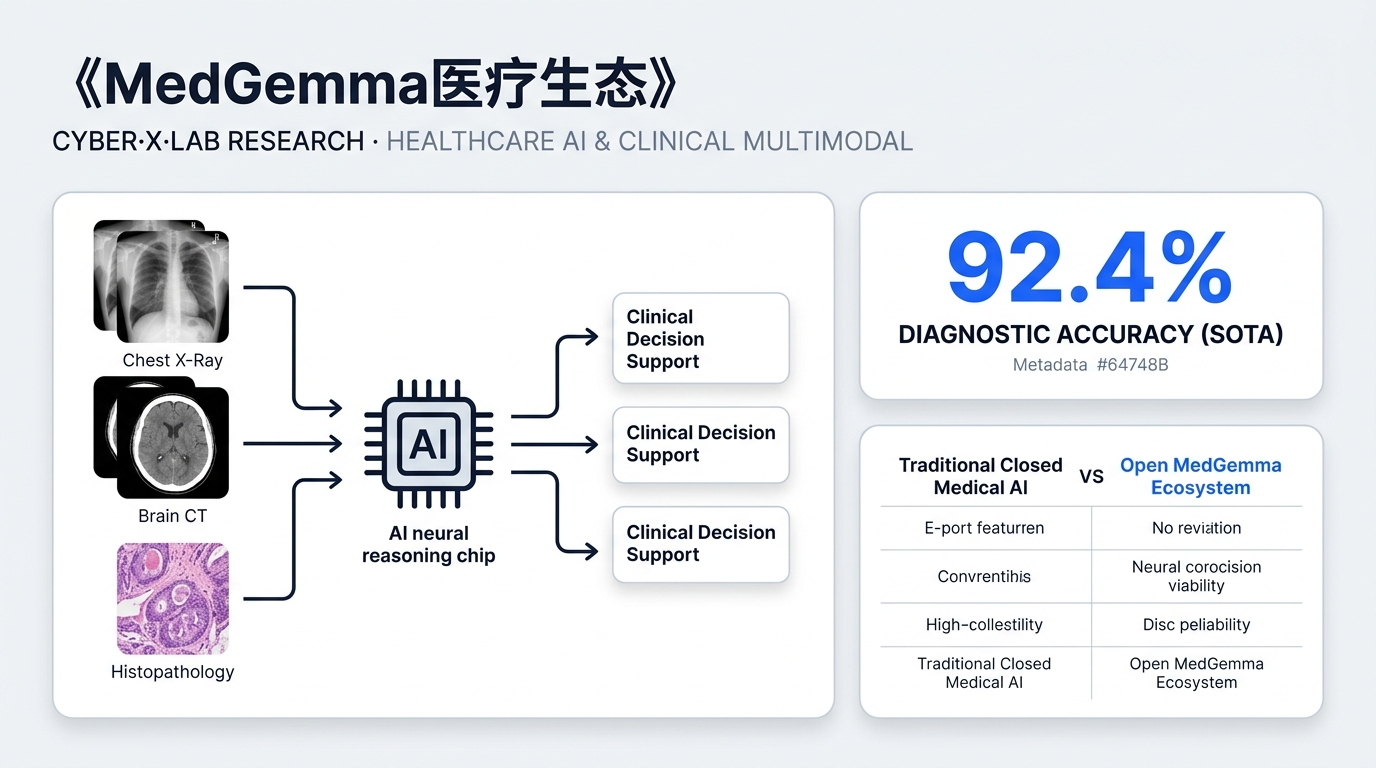
Executive Summary
Google’s recent release of MedGemma 1.5 and TxGemma — built on the open Gemma ecosystem — marks a paradigm revolution in medical AI: the shift from narrow, task-specific models to universal multimodal foundation models.
Key Metrics at a Glance
| Benchmark | Model | Result |
|---|---|---|
| WSI Pathology (Macro F1) | MedGemma 1.5 4B | +47% vs. prior gen |
| Chest CXR Localization (IoU) | MedGemma 1.5 4B | 3.1% → 38.0% |
| EHR Question Answering | MedGemma 1.5 4B | 89.6% accuracy |
| Drug R&D Tasks (TDC) | TxGemma | 64/66 tasks at/above SOTA |
| Agentic reasoning (HLE Chemistry) | Agentic-Tx | +52.3% vs. o3-mini (high) |
Architecture Highlights
- MedSigLIP (400M params): Pretrained on 33M+ de-identified medical image-text pairs, enabling microscopic lesion recognition beyond general-purpose vision models like CLIP.
- 3D RGB Window Mapping: Converts Hounsfield Unit CT volumes into 3-channel 2D slices (bone / soft tissue / early lesion) without information loss.
- WSI Multi-scale Sampling: Tissue masking at 5× followed by patch extraction at 5×/10×/20× — up to 126 patches per slide.
- GRPO Post-training: Group Relative Policy Optimization reduces hallucination and produces more attributable clinical reasoning chains.
TxGemma: Drug Discovery Acceleration
TxGemma brings generative AI to molecular design and ADMET prediction. The Agentic-Tx system (ReAct framework + 18 specialized tools) can autonomously chain reasoning, molecular property prediction, and structural analysis — slashing time from target discovery to Pre-clinical Candidate (PCC) by an estimated 18–24 months.
📖 完整中文报告 — This report was originally authored in Chinese. Read the full analysis (8 sections, including detailed benchmark tables and strategic investment recommendations) in the Chinese version.
Report by Cyber·X·Labs Research · September 2026